Why this Meal Plan is Different
Stop replanning dinner every single week. This course teaches you how to plan meals once a month instead — starting with inventory (what you already have), building a plan around it, and using two shopping lists (one big, one for perishables) so nothing goes to waste. It flexes for real life — good deals, family preferences, plans changing — instead of fighting it, and works on any budget, for one person or a whole household.
By turning weekly meal planning into monthly planning, food cost turns into a monthly expense that matches your other bills: rent, insurance, utilities, and others you have to pay once a month no matter how your income lands. (Paid weekly? Irregularly? Still works — Lesson 16 shows you how.) It also means less exposure to impulse buying of things you don’t need.
One thing this isn’t: Taco Tuesday with better branding. You won’t find borrowed theme days here. You’ll build a rhythm around your own household — not somebody else’s calendar.
When I switched from chasing sales with no plan to running the month as one shop, I saved $50 a month. Almost immediately.
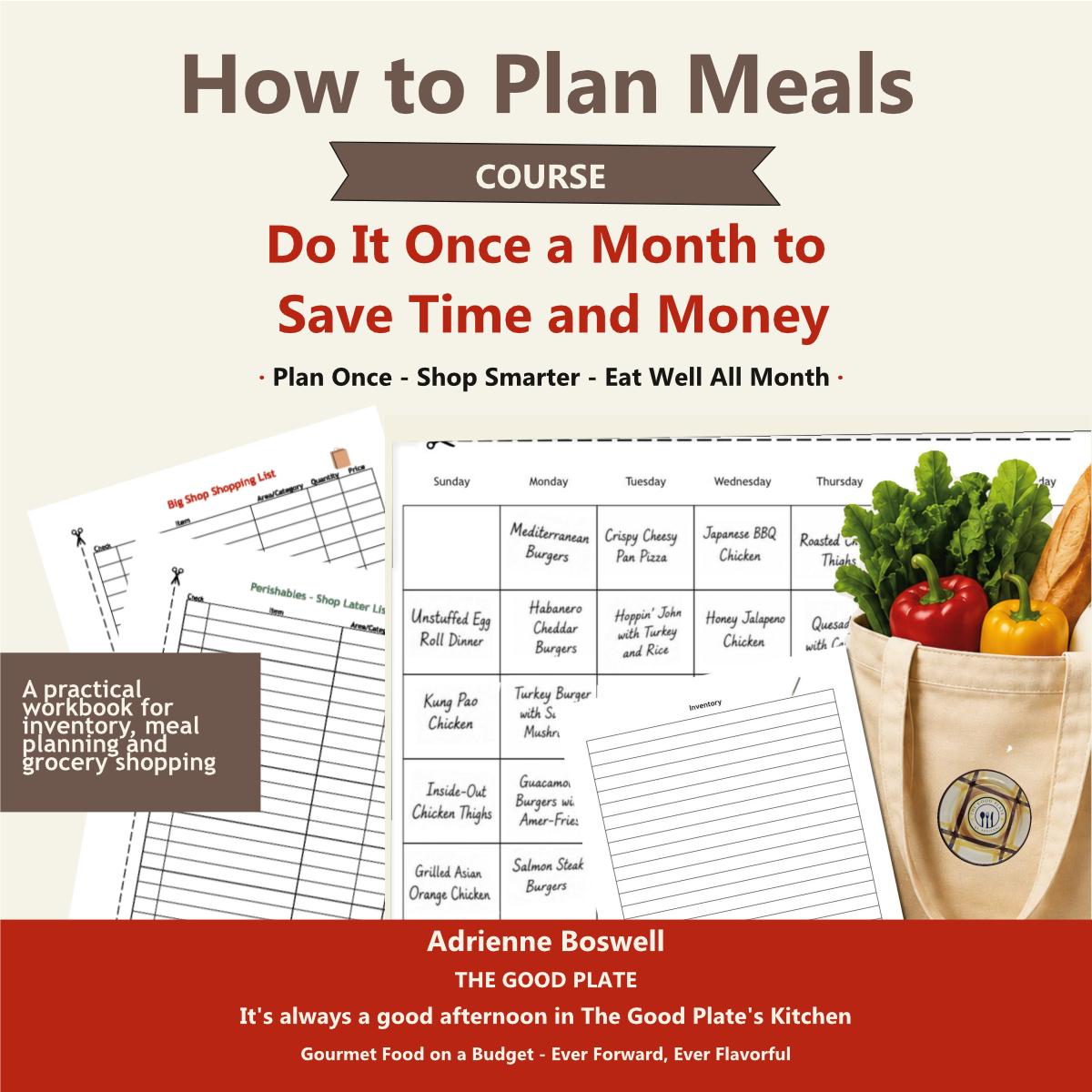
Normally, $60.00, early students get it at $22.99 before the price goes up.
What’s Included
- The full course — 3 sections, 17 lessons
- Course activity sheets
- A coupon for free reprints of your planner pages — so a torn or used-up tear-out never leaves you stuck
- A discount on the fillable PDF workbook — use it on any device, no printer required
Who is this Course For?
This course works for any budget, any diet, any household. Your money might arrive weekly, biweekly, or daily, but actual financial obligations (rent, car payment, insurance, etc.) run monthly. Every tool that shows a weekly view is asking you to manage the wrong unit. You can hit every individual weekly bar successfully and still not make rent by the 28th, because the tool was never measuring the thing that actually matters.
- It doesn’t make a difference when you get paid, bills are still once a month.
- Decision fatigue, ADHD, or just tired of thinking about dinner every single week
- Keto, Mediterranean, gluten-free, vegan, low-carb, calorie counting, or any other set of rules you’re following — the system doesn’t care what diet you’re on, it just makes it easier to stick to
- Planning a party and deciding between caviar and cheese-and-crackers — same math, different stakes
Why Once a Month, Not Once a Week
Every week you re-solve the same puzzle: what’s for dinner, what do we need, back to the store. That’s 52 planning sessions a year — 52 chances to grab something that wasn’t on the list, 52 trips where impulse buys chip away at the budget you set.
Plan meals once a month instead, and you do the thinking one time. Then you’re done — for four weeks.
How You Shop
Supermarkets are there to make money. Manufacturers pay for placement at the store so goods are at eye level. They want you to shop in the middle of the store. They put impulse items to encourage you to buy them, whether you need it or not. Manufacturers pay real money for that eye-level spot — it’s a well-documented industry practice called a slotting fee.
Some of us shop the manager’s-special rack and build meals around whatever’s marked down that day. That’s not a bad instinct — it’s actually planning, just aimed outward at the store instead of inward at your own kitchen. This system takes that same instinct and points it at what you already have first, so you’re not always starting from zero.
But one thing that you will miss when you plan meals according to this system: you won’t go to the store, bring home 3 cans of tomatoes because they were on sale, and realize you already had 3 cans in your cupboard.
The Lessons in How to Plan Meals
Section 1: The Promise
Section 2: The System
Section 3: The Math & The Proof
Here’s How Planning Meals Once a Month Works
- Know what you have first. Before you plan anything, you take stock — pantry, fridge, freezer. This is the step almost every planner skips, and it’s the one that changes everything downstream.
- Build the month around it. Turn what you have into meals, plan leftovers on purpose, and leave room for easy days when you just don’t feel like cooking.
- Two lists, not one. A Big Shop list for the month, and a separate Perishables list for what you’ll pick up later — so nothing rots in the back of the fridge waiting to be used.
- Do the math that actually matters. Cost-per-plate thinking. Unit pricing, so “buy 10, save a dollar” stops fooling you.
And even with a list in hand — see cod at half price? Grab it. That’s not breaking the plan, that’s the plan working. It goes straight into next month’s inventory, right alongside everything else you already have. Nothing wasted, nothing “wasn’t supposed to happen.” The system was built to catch deals like this, not fight them.
And because a plan is only as good as the paper it’s on, enrolling comes with a coupon for free reprints of your planner pages — so you never run out, no matter how many months you’ve been at this.
This Isn’t a Contract
Plans change. Tuesday shows up and nobody wants what’s on the list — that’s fine. The system still works, because you still know what you have. This is a tool, not a mandate.
Built for Real Households, Not Just Recipes for One
Planning for a teen with allergies, a picky eater, someone who wants more protein? The system flexes — build a base everyone can eat, then let individual pieces adjust.
Where Do I Get Recipes?
Why, you can get recipes here or The Good Plate, of course!
Course Instructor

A note on where this came from: I didn’t design this system on a whiteboard. It started in November 2015, out of necessity, for one Thanksgiving. December turned out to need planning too, since it was the next month. By January I realized I was onto something — and it’s been saving me time, money, and mental energy for over a decade since. Don’t take my word for it — the current month’s plan is live on The Good Plate right now, same as it is every month, because that’s the whole point.
Why Planning Beats Winging It
Meal planning has a reputation problem. It takes too long. It’s not worth the effort. You won’t stick to it. You don’t have the resources. It’ll feel like eating from an institution — or worse, you’ll think you have to make it Pinterest-perfect. This course takes on all of it, starting with the biggest one: that eating healthy is going to cost a fortune. Spoiler — that’s not a price problem. It’s a planning problem.
- You stop deciding when you’re hungry. The worst time to make a food decision is when you’re already hungry and tired. A plan means that decision already got made, back when you had the bandwidth to make it well.
- Less food gets wasted. No plan means buying on impulse and guessing — and guessing means that thing you grabbed because it looked great in the store turns into a science experiment in the back of the fridge three weeks later. 🧫 A plan means you buy what you’ll actually use, before it starts growing its own ecosystem.
- You eat better without trying harder. Planning isn’t about willpower at dinnertime, it’s about setting yourself up in advance so the easy choice and the good choice are the same choice.
- It protects your budget, period. Every unplanned trip to the store or unplanned order for takeout costs more than the version you would have made at home.
